The work of M.C. Escher can be thought of as related to animation, for example, his long print Metamorphosis. But Escher didn’t need an animation technique, instead finding his own solutions. A square slowly changes shape and other recognizable shapes—such as birds and fish—emerge precisely because of the clear visual language that Escher developed. Looking more closely from this perspective, are there perhaps other wonderful worlds that will become visible? Join Dutch mathematician Rinus Roelofs and Authorized Rhino Trainer for a closer look at Escher’s work, a great source of inspiration from which unexpected moving images have arisen. Math Encounters is MoMath’s popular free public presentation series celebrating the spectacular world of mathematics, produced with support from the Simons Foundation.
In this video, Edwin Hernández from ShapeDiver explains how to significantly improve the workflow and performance of your models by using math and transformations. Watch this video and learn different methods to ensure your Grasshopper models run efficiently on ShapeDiver.
Peter Donders has been kind enough to share his latest "Alienometry" models, all done in SubD, imagining how aliens could look.
"The gold armor mask is to make them look more human,
no arms, no legs, all is mind controlled.
They hover on whatever gravity is available on whatever planet. They transport in the Mech Eggs.
Bringing the message, "There is no time only from point A to point B; the faster you can move, the less 'time' you need to get there." You could have been there in quantum space even before you went there.
The physical model will be 3D printed and hand-finished blue silver leaf and gold leaf, and come in two sizes: small 224 x 113 x 314mm and big 448 x 226 x 628mm. Available on demand.
Taking a stance against mass production and fast fashion, Gemme, an iconic jewelry brand, crafts unique 3D-printed pieces upon request.
In this interview, Alexander Drachenberg and Jennifer Greco, cofounders of Gemme, share how the company started, the unique concept they are presenting with their brand, and the different technologies powering their online store, such as Grasshopper, ShapeDiver, and Shopify.
It also covers the different aspects of their design workflow and their vision regarding their brand's future and the jewelry industry.
The #glTF 2.0 format has become the standard format for 3D content. It is supported by widely used software (Blender, SolidWorks, Revit, Cinema4D, Maya, SketchUp, etc.) and 3D engines (Unreal Engine, Unity, Babylon.js, Three.js, etc.). Thanks to the ShapeDiver plugin for Grasshopper, you can now create glTF files via Grasshopper.
Edwin Hernandez has posted a newvideo tutorial in the ShapeDiver channel where he explains the glTF format, how to create glTF files with Grasshopper, and how and where to use these files (Facebook, SketchFab, Shopify, and even the metaverse!).
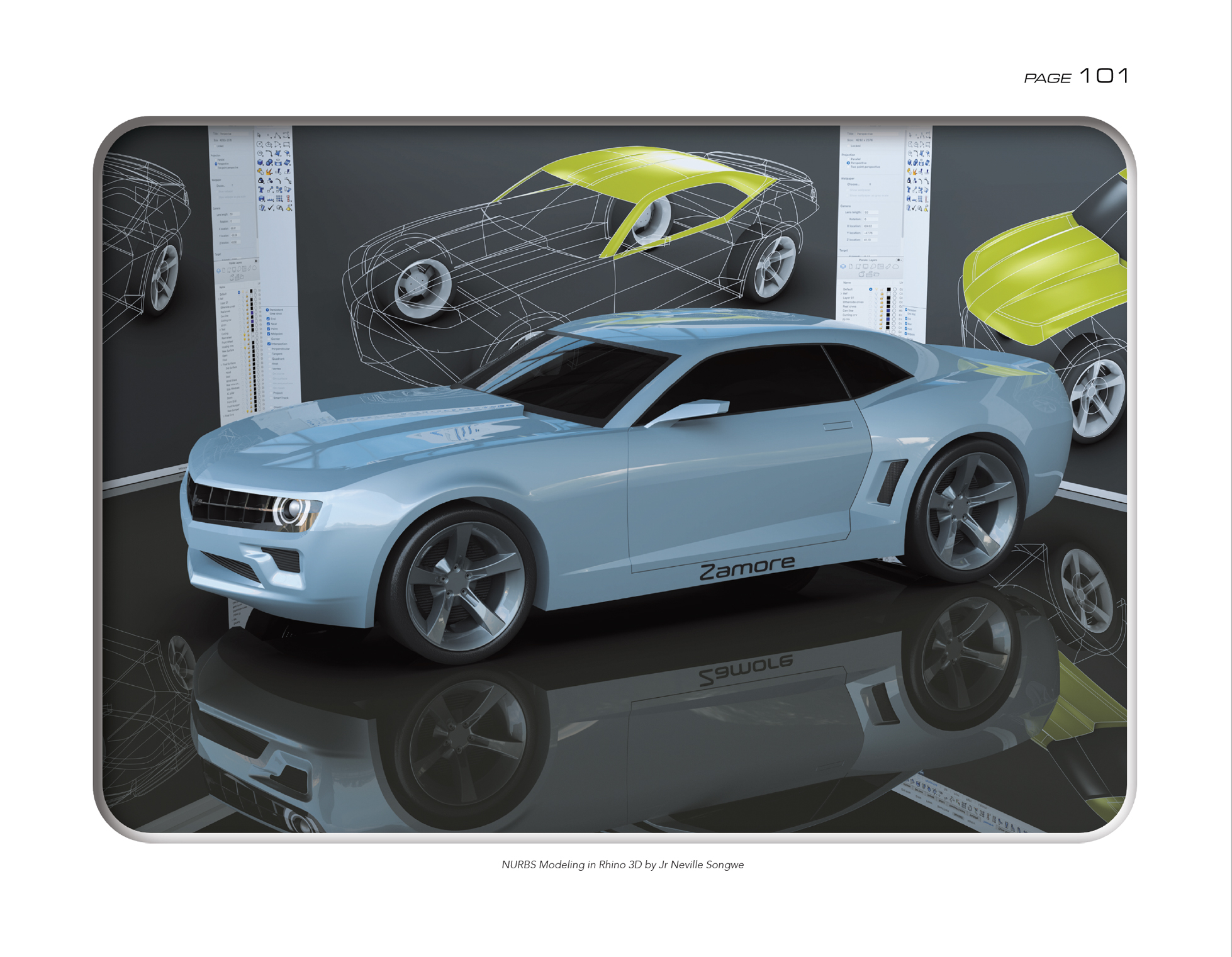
This book targets industrial design students, design professors, design practitioners, and others interested in industrial design (product design). It offers a guide or roadmap by providing: Design Templates, 7 Historic timelines, 50 Schemas, 100 Drawings, and Illustrations. Rhino (NURBS and SubD) was used to develop and illustrate all the 3D CAD concepts in the book, featured on pages 2, 7, 11, 57, 87, 101, 180, 206, and 207.
The book is available for purchase from the following links:
CrossGems is a professional jewelry software that allows you to design any complex model easily and quickly without having technical CAD knowledge.
Core and Features
All objects are linked in real time to automatically adapt when edited, allowing you to delete or modify Boolean operations or any of the 100+ CrossGems tools and keeping the parametric history in all cases. Additionally, this feature applies to Rhino gumballs, allowing you to reset transformations (move, scale, and rotate) applied to model parts and restore deleted document objects at any time, including SubD objects and Meshes, while maintaining compatibility with Rhino's Record History function.
It can also be used as a traditional modeler without the parametric system, adding the modeled objects as normal Rhino geometry.
For the most advanced users, all the tools in Rhino are also available in Grasshopper, making it one of the most versatile software in the Rhino world.
Interface
CrossGems can be run with its own interface, simplifying the workflow and as a Rhino plugin while keeping all the parametric features for users used to Rhino UI. The Command History Panel, available in Rhino and CrossGems UI, is the visible part of this system that allows the user to interact with and manage all the model components.
Rendering
It also includes a rendering material library with over 300 materials and grounds for the integrated physics-based render Cycles.
Materials and grounds are assigned with a single click, displaying the object weights in real-time while using any tool or simply selecting objects in the document. Furthermore, CrossGems will automatically swap materials when changing display modes to achieve the best quality for every situation.
Compatibility
CrossGems is capable of importing and converting gems from other software, such as RhinoGold and Matrix, as well as importing Panther files while maintaining 100% parametric history.
About CrossBytes 3D
CrossBytes' background goes back to the origins of RhinoGold, developing from RhinoGold 3 to RhinoGold 6.5 for more than ten years. Finally, the company was acquired by a multinational. At this point, CrossByte created Panther 3D, the world's first parametric jewelry software from Rhino and Grasshopper. CrossGems is its evolution in every respect.
"Throughout all these years we have learned thanks to listening to users and we can say that we have built a program with jewelers and for jewelers within the reach of anyone and we intend to continue doing so, so if you have any requests, doubts, or suggestions feel free to email us at hello@crossbytes3d.com."
Learn parametric design without prior coding experience in just eight weeks
Krzysztof Wojslaw from LearnGrasshopper will guide you through the transformation from an "old-school" engineer with zero programming experience to an engineer of the future who can automate manual tasks and have much more fun at work.
Krzysztof Wojslaw, the training author, will answer all questions connected to the learning platform and how to start with Grasshopper completely from scratch.
The 2Shapes team is happy to announce 2Shapes Design 4 for Rhino, the newest version of the jewelry design plugin for Rhino. Developed by the industry leaders that made RhinoGold and Clayoo, this new version gathers all the experience learned over the years, solving the needs of jewelry design professionals.
2Shapes 4 for Rhino includes many improvements and new features that make it one of the most powerful programs on the market today.
Construsoft is a leading supplier and developer of BIM (Building Information Modeling) software and related services. Their portfolio includes products and applications that provide an accurate, detailed, and data-rich 3D environment for the design and construction industry.
They were interested in creating a free online application that would allow them to showcase their knowledge for calculating and optimizing the design of metal structures. They knew Grasshopper was a powerful tool to build such an application, but they needed a way to host these files online and make them available to anyone via a web browser. Recently, they found out that ShapeDiver could give them these capabilities and even allow them to use third-party plugins such as Karamba3D and Geometry Gym.
In this interview, ShapeDiver talks with Construsoft's team and discusses the topics surrounding this powerful online tool called Optinave.
Learn how Rodrigo Aranha Lopes, a Brazilian architect and surfer living in Portugal, created this award-winning project that aims to change surfboard manufacturing with the help of parametric design, cloud computing, and subtractive manufacturing.
At the beginning of the structural design process, there are two common approaches to defining geometries: Create complex and parametric geometries directly using Rhino and Grasshopper or leverage the power of Rhino.Inside to transfer geometry directly from Revit.
Now, with CondorShell, engineers can easily export geometry and data from Rhino and Grasshopper to SAFE V20.3.0, making the structural analysis and design much faster. With CondorShell, engineers can create workflows to automate design tasks in the design of foundations and the design of slabs in CSI SAFE.
CondorShell is a Grasshopper-based component just released by Artificial Intelligence Optimization Software, LLC (AIOS). CondorShell 1.0.0 is available to download beginning October 10.
CondorShell comes in two versions: Basic and Pro. There is extensive documentation as well as short videos and examples that illustrate the use of every single CondorShell component. Both versions will help you establish more efficient workflows, saving valuable time during design.
CondorShell Basic: Available using the PackageManager in Rhino, this free version features 20 components that support the creation of your SAFE model. See the 1-minute video tutorial, How to Install CondorShell Free Limited Version.
CondorShell Pro: To experience the full capabilities of CondorShell, users can upgrade to the paid version which provides 54 additional components that facilitate the creation of complex geometries in your SAFE model. To activate the Pro version, follow the installation instructions in the 3-minute video tutorial, Installing CondorShell.
Digital Fabrication in the Architecture, Engineering and Construction industry, requires the combination of various toolchains and software platforms, across the boundaries of multiple scientific, socio-economic and technological domains, into efficient pipelines for integrated computational development and project delivery. Over the past 6 years, the NCCR Digital Fabrication at ETH Zurich has greatly invested in the development of COMPAS, a comprehensive open-source computational framework written in Python, that aims at streamlining these multi-disciplinary workflows and the integration of state-of-the-art tooling to simplify their adoption by architects, designers and researchers from within parametric design environments.
In this 3-day workshop, Tom Van Mele of Block Research Group and Gonzalo Casas of Gramazio Kohler Research will introduce participants to COMPAS by providing an overview of the functionality of the core framework, the extension packages, the UI system, and its relation to CAD software. Together with the participants they will then step-by-step explore an example application focused on the modeling, equilibrium analysis, and robotic fabrication of a discrete assembly.
By the end of this workshop, participants will be able to:
Use the geometry kernel and core data structures of COMPAS.
Exchange data between different processes, plugins and tools.
Design a simple discrete element model, identify the interfaces between the blocks, and manage block interactions with a specialized data structure.
Calculate the required conditions for equilibrium.
Analyze and explain the kinematic structure of a robot model based on its URDF model.
Apply fundamental building blocks of robotics (forward and inverse kinematics, cartesian and kinematic planning, planning scene).
Design and plan stereotypical assembly processes (e.g. bricklaying) in simulation, and execute them in a simulated robot environment.
Day 1: Focus on core framework
Overview of COMPAS framework
Geometry & Data structures: deep dive into the geometry kernel.
Packages & Extensions: an overview of the ecosystem.
Integration with CAD: geometry representations and artists.
Remote Procedure Calls: leveraging the entire Python ecosystem from within the CAD.
Plugins & Tools, creating and distributing Grasshopper components in pure python.
Discrete element Models: Blocks, Interfaces, Equilibrium
Parametric generation of discrete wall geometries using the assembly data structures.
Definition of boundary conditions and interfaces recognition;
Equilibrium evaluation of the assembly sequence using the solvers available in COMPAS Masonry;
Global equilibrium of the structure subject to self-weight and after the application of different loading conditions.
Robotic fabrication:
Fundamental concepts of robotics: control modes, positioning and singularities, robot coordinate frames and transformations
Description of robot models and the URDF format.
Forward Kinematics and Inverse Kinematics (analytic and numerical solvers).
Robotic backends: ROS (Robot Operating System) and the MoveIt! Motion planning framework, Pybullet, pure-python solvers.
Path planning: Cartesian and kinematic path planning. Goal constraints definition.
Planning scene manipulation. Dynamic end-effector attachment and detachment.
Prototypical structure of pick and place applications.
Sequencing and planning of a discrete element model for robotic fabrication.
Robot control (ABB and UR).
Day 3: Integrative project
Procedural generation of curved wall geometry.
Conversion to assembly data structure.
Methods for interface detection.
Stability assessment of intermediate assembly stages.
Stability assessment of complete structure.
Path planning for robotic assembly.
Fabrication simulation.
Course requirements: Participants are expected to be familiar with Rhino/Grasshopper and have at least a basic knowledge of python programming.
Online course fees: EUR 395,- (+VAT); full-time students and university teachers get a 50% discount (proof of status required). Please note that we will confirm your seat after your payment has cleared.
Max. number of participants: 25. If there is no quorum, the course will be canceled two weeks before.
Course language: English
Educational seats are limited. Sign up now by contacting McNeel Europe!
French speakers seeking documentation about Grasshopper in their native language now have Conception Paramétrique Avec Rhino et Grasshopper, a new book by Jean-Pierre Couwenbergh and Mohamed-Anis Gallas.
The book is not only a presentation of the fundamentals of parametric design but also a practical guide to Rhino and Grasshopper with exercises that readers can download for practice. The manual also covers the connections between generative design and BIM through Revit and Archicad.
Follow along with Edwin Hernández as he shows you how easy it is to visualize Grasshopper files in AR with the help of ShapeDiver and any mobile device!
Join Andres Gonzalez for a free short chat open to the general public about learning 3D Parametric Design for Jewelry with Rhino and Grasshopper, and learn how to automate Rhino 7 using Grasshopper to improve the possibilities of discovering new forms and reduce the time modeling repetitive families of 3D objects.
Date: September 30, 2022.
Time: 10 a.m.
Place: Auditorio Ignacio Vieira
Escuela de Arquitectura y Diseño, UPB, in Medellín, Colombia.
Visit this link and take a look at some simple exercises.
We have done it before with a group of students from TEC of Monterrey, campus Guadalajara and you can look at the resultsof the students that were learning Parametric Design for the first time!
Andres is the head of the McNeel Southeast US and Latin American Division and founder of Rhino3D.Education. He is also the worldwide director of RhinoFabStudio and the Generative Jewelry & Fashion Design community GJD3D.
Rhino3D.Education offers online courses in Rhino, Grasshopper, Computational Design, GhPython, PanelingTools, RhinoCAM, V-Ray, and more. Check it out!
Macu4 is a Swiss startup using parametric design and 3D printing to radically transform how arm prosthetics are made. They saw that traditional offerings were not only heavy to wear and expensive, but the whole process took too much time. They knew they could shorten the entire process by using parametric design to easily customize each patient's forearm and then 3D printing to manufacture each part. The only missing link was finding a solution allowing them to host their Grasshopper file on their website and output the suitable production file for every patient. So how did they solve it? Read along to find out!
We noticed this nice list of various Rhino.Inside and Grasshopper integrations, BIM in Grasshopper Ultimate Software List. This post by BIM Corner includes information on Tekla, Revit, Archicad, BricsCAD, Quadri, RhinoInsideCadwork, VisualARQ, Geometry Gym, and MKS BEAM.
We have a Getting Started web site to help you get going in Rhino. It's full of short video tutorials. Most are less than five minutes long. The various topics include tutorials on navigation, selecting objects, modeling strategies, and Grasshopper basics. Both Windows and Mac are covered.
The Arqueha studio, coordinator of Plan Zero for the climate transition of three neighborhoods in the city of Valencia, has been in charge of the project's technical development, applying prefabrication and sustainability parameters. With digitization through the BIM methodology and parametric design, it has been possible to turn a unique building into a reality.
The use of parametric design applied to the enclosure has provided the ability to generate a fully controlled distribution of slats, choosing the density and position of each one in the racks and obtaining a unique design for each rack.
This has been possible thanks to Rhino.Inside Revit, which has allowed working in a coordinated manner with Grasshopper and Revit to generate both the geometry and its associated parameters that have been attributed differently to each of the more than 1000 pieces that make up the racks.
Thanks to these processes, the waste generated, the work carried out and the transport of materials have been reduced, saving significant amounts of CO2 and energy. Àgora València is also a space studied following thermal comfort strategies.
The 3D model used for analyzing sunlight and outdoor comfort has been extracted directly from the BIM model and processed with Ladybug.
A project as unique as Ágora València, with the high level of detail it presents, as well as the precision required in coordinating industrialized elements produced by different agents, would not have been possible without the use of Rhinoceros.
New version of Lark Spectral Lighting Grasshopper plugin
Why is this relevant?
Our eyes have a dual function: They allow us to see, but they also mediate several psychological and physiological (non-visual) responses. Light reaching the eyes regulates circadian rhythms and affects alertness. Since we spend most of our time indoors, building designers are responsible for providing healthy indoor lighting. A simulation tool is now available to help meet this challenge.
New version of the Lark simulation tool
Lark Spectral Lighting 2.0 is available on food4Rhino with new features, components, and templates to investigate non-visual lighting design. Lark is a plugin that helps architects, designers, and researchers examine a lighting design's effect on circadian rhythm and alertness.
The updates in Lark 2.0 include:
Ability to run daylight and electric light simulation
Calculation of spectral irradiance and output metrics relevant to the non-visual effects of light according to the CIE (α-opic metrics)
Analysis workflow that accounts for the direction in which light reaches the human eye, which is relevant for non-visual effects
Simulation of a period of light exposure and analysis to optimize alertness according to a light-driven biological model
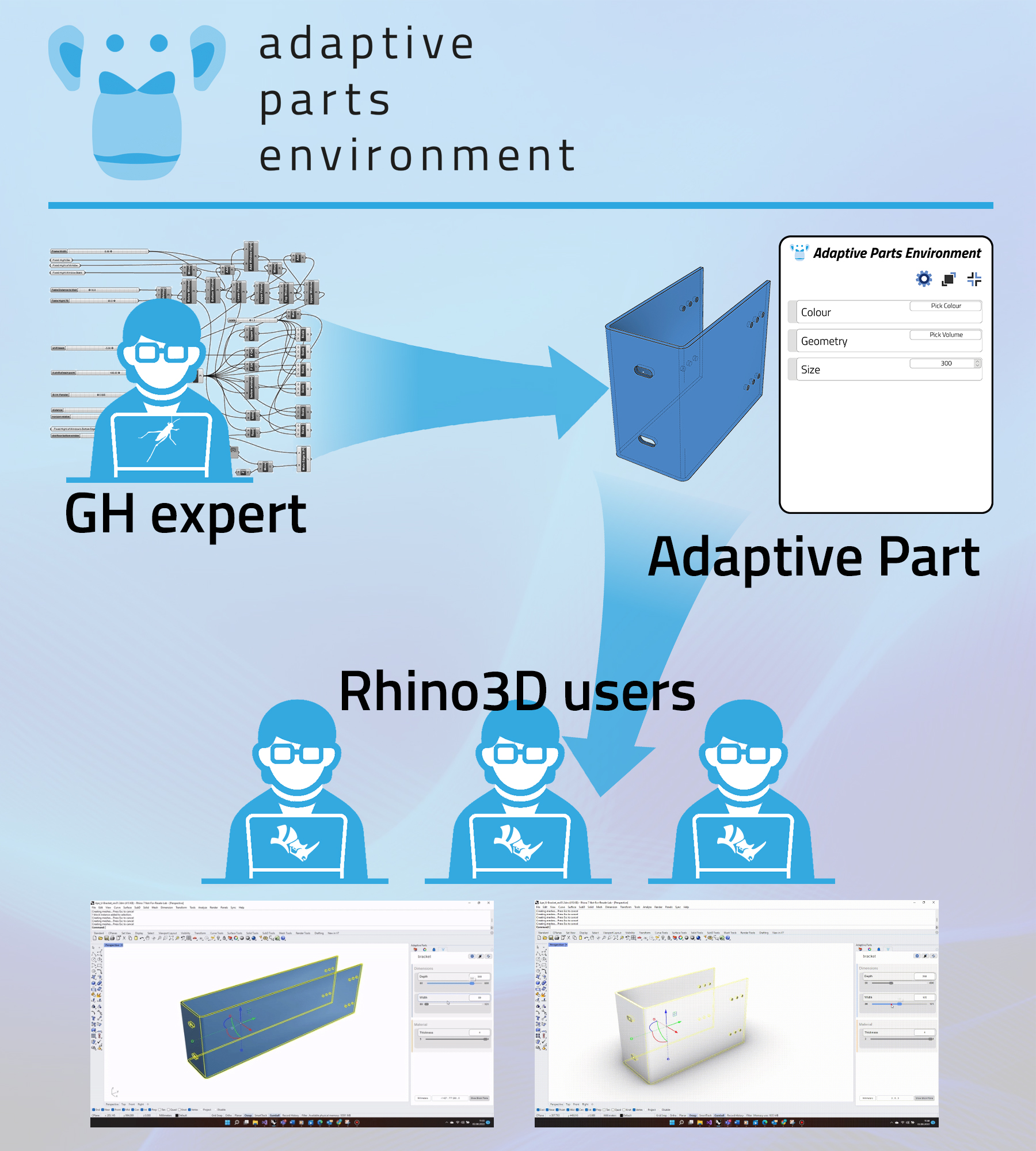
Even without Grasshopper knowledge, everyone should be able to access Grasshopper’s parametric power. Therefore, Rhenso GmbH has developed Adaptive Parts for Rhino 3D—objects with dynamic geometry and properties—that everyone can easily manipulate with a user-friendly UI.
The users know best which tools they need, and most off-the-shelf CAD software does not provide them. So, this plugin intends to enable everybody to design their own tools for improving workflows that fit their needs best.
Adaptive parts are similar to dynamic blocks but way more powerful. They can be almost anything you can imagine and build with Grasshopper.
To use an Adaptive Part, Grasshopper knowledge is not required. To create one, it is.
Adaptive Parts are created in Grasshopper and wrap design and process knowledge into closed and shareable bits. They can be shared with your team members, only exposing the relevant parameters without exposing the (sometimes confusing) Grasshopper canvas.
"The Adaptive Parts Environment Plug-In is currently Work-In-Progress (WIP) and being actively developed. We are currently adding new features and integrating user feedback with every WIP release. Our plan is to be feature complete and stable for a commercial lease in late 2022."
Dana Buscaglia has published two new books to demonstrate and teach using Rhinoceros 7.0 for the design and creation of jewelry modeling.
The first volume covers basic Rhino commands and the 2D project creation. The second volume covers basic Rhino commands and the 3D project creation. The chapters are in tutorial format with step-by-step instructions that gradually build a knowledge base, becoming more advanced in later chapters.
Dana Buscaglia’s 40+ years of experience in jewelry ranges over various segments of the jewelry industry. After designing and executing her line of contemporary jewelry for 13 years, Dana moved to a more commercial side and took design jobs at Jacmel Jewelry and then at Avon. Both experiences exposed Dana to the different worlds of jewelry design and mass production.
As outsourcing became important, involving the transmission of accurate product design and description to contractors worldwide, Dana became interested in Computer Aided Design to easily and accurately transmit drawings and layouts. She became adept at AutoCAD and then branched into Rhinoceros because of its ability to create both drafted 2D drawings and 3-dimensional models.
Dana’s design experience is an advantage when translating the work of other designers into technical drawings and layouts or 3-dimensional digital models for prototyping.
Dana has also become a licensed Rhino instructor and teaches Computer Aided Design at the Fashion Institute of Technology.
Optimus is the industry-leading Process Integration and Design Optimization (PIDO) software platform, bundling a powerful range of capabilities for Engineering Process Integration, Design Space Exploration, Engineering Optimization, and Robustness & Reliability. These PIDO technologies help direct engineering simulations toward design candidates that outsmart competition while considering all relevant design constraints—effectively implementing an Objectives Driven Engineering process. Optimus users report design time savings averaging over 30% while achieving 10% or more design performance improvements.
The Grasshopper interface automates using Grasshopper as a component of an Optimus workflow. It allows users to access all Grasshopper-defined design parameters (*.ghx file) and the parameters of the simulation setup and submit the updated files to Rhinoceros.
Optimus automatically modifies the Grasshopper design parameters and generates and updates the underlying Grasshopper files to be used in a multi-disciplinary DOE, optimization, or robust design workflow.
There are two common approaches to defining geometries at the beginning of the structural design process. Engineers can create complex and parametric geometries directly using Rhino and Grasshopper, or leverage the power of Rhino.Inside to transfer geometry directly from Revit. With CondorShell, engineers can now easily export geometry and data from Rhino and Grasshopper to SAFE V20.3.0.
CondorShell is a Grasshopper-based component just released by Artificial Intelligence Optimization Software, LLC (AIOS). CondorShell 1.0.0-beta is available to download beginning July 15.
CondorShell comes in two versions: Basic and Pro. Both versions will help you establish more efficient workflows, saving valuable time during design. Extensive documentation is included, as well as short videos and examples that illustrate the use of every single CondorShell component.
CondorShell Basic: Available using the PackageManager in Rhino, this free version features 20 components that support the creation of your SAFE model. Watch the 1-minute video tutorial that shows how to install it.
CondorShell Pro: To unlock additional components and experience the full capabilities of CondorShell, you can upgrade to the paid version, which provides 54 components that facilitate the creation of complex geometries in your SAFE model.
For the duration of the beta test, the cost of our Pro version is waived to enable design professionals to test and provide feedback on the complete functionalities of the plugin. To activate the Pro version, follow the installation instructions in the 3-minute video tutorial, Installing CondorShell.
The beta period will run through August 5, 2022, when all beta licenses expire. Send your feedback to support@aiosciv.com. Happy coding!
The plugin day1bim Tools is a set of conceptual massing and programming tools for architects, allowing them to quickly develop a project concept model and extract fundamental project information. Version 1 is now published on food4Rhino.
The concept model developed can be used for simulations and representations. With Grasshopper-based connections, the geometry can be linked forward to generate native elements in a BIM environment. It’s a flexible model ready to visualize in minutes and easy to modify. It’s not about making conceiving architecture easy. It’s about making BIM elegant. It lets you work directly, intuitively refining the 3D model. The script manages the data and live updates.
From a simple arrangement of forms in solid and void, rapidly generate powerful project data for building mass and program. It’s a quick start to develop concept forms to visualize and elaborate your idea. It uses fundamental skills in manipulating geometry in Rhino. And it takes advantage of many available, but often little-known, Rhino tools that are advantageous for architecture projects. It leverages Grasshopper to manage and update the geometry and data. It works within Rhino and Grasshopper in a natural way. This help users new to modeling and algorithmic environments understand their function's logic. They access many common tools for, linking data, generating representations, annotations, and export geometry. The plugin is free for students… and very reasonably priced for commercial use.
With Rhinoceros 7 and Grasshopper algorithms, create models easily, enable simulations, modify, iterate and find better results by manipulating Grasshopper parameters.
The videos and book help you create jewelry designs using these latest computational design techniques. Discover the many possibilities your design may offer with the help of Grasshopper.
The paperback is available on Amazon, or grab the PDF Book and models for everything you need to complete the exercises.
Akiyo Matsuoka and Eva Tucek, Authorized RhinoTrainers (ARTs), bring their years of knowledge and experience in Rhino and Grasshopper to those who want to learn CAD for jewelry design.
Point cloud data has massive potential for AEC professionals. But working out how to use the data has been tricky—and for Rhino users has often led to workarounds that devalue the data.
In this blog Mark Estcourt, Managing Director of Veesus, shares his thoughts on integrating point cloud data into your workflow, using Veesus’ revolutionary plugin to work natively with point cloud data in Rhino.
The course is free and available to all professionals. It includes two Professional Development Hours (PDH) based on the criteria of Landscape Architects Continuing Education System. ASLA members will get an attendance certificate.
Veris has to deliver the highest quality 3D models and point cloud data to clients. So when a crucial point cloud tool was discontinued, Veris partnered with Veesus to overhaul their reality capture tools and digital construction workflows using Veesus Point Clouds for Rhino. Now, they’re delivering better results than ever before for clients, using the Veesus plugin to work with point cloud data natively in Rhino.
Founded in 1980, McNeel is a privately-held, employee-owned company with sales and support offices and affiliates in Seattle, Boston, Miami, Buenos Aires, Barcelona, Rome, Tokyo, Taipei, Seoul, Kuala Lumpur, and Shanghai with more than 700 resellers, distributors, OEMs, and training centers around the world.




.png)




.jpg)


.jpeg)


 Subscribe
 Posts
Posts

