Friday, March 20, 2026

The Grasshopper Paradox – Tool Agnostic Mind-set


In this lecture, Dr. Milad Showkatbakhsh, Director of AA EmTech, explores the evolving role of the architect through what he terms “The Grasshopper Paradox”. While the contemporary designer must strive to be entirely tool-agnostic to survive a rapidly shifting technological landscape, a platform like Grasshopper remains the most vital vehicle for reaching that mental framework. At the heart of the presentation is a focus on computational thinking, the ability to decompose complex architectural problems into modular, systemic, and solvable processes. By positioning design at the interface of nature’s evolutionary logic and machine intelligence, Dr.Showkatbakhsh demonstrates how AA EmTech utilizes a “Digital-Physical Continuum” to bridge the gap between material constraints and digital extension. The lecture highlights the shift from the architect as a sculptor of form to an editor of data, where tools like Grasshopper act as an explicit canvas for navigating informed decision-making through data-rich environments and evolutionary histories. Drawing on applied research and the recent AD Magazine contribution, “From Genome to G-Code”, the talk outlines a pedagogical mission: moving away from teaching software toward a deep, systemic integration of applied computational logic. Ultimately, the lecture argues that while tools and platforms will inevitably come and go, the resilience of the architectural discipline lies in cultivating a community of problem-solvers who can translate the complex mathematics of the natural world into the language of the machine.

About the speaker:

Milad Showkatbakhsh is an accomplished architect, educator, and researcher with an extensive international portfolio in computational design and emergent technologies. He is the Director of the renowned Emergent Technologies and Design [EmTech] postgraduate program at the Architectural Association School of Architecture (AA), where he also leads the AA DLAB and AA Istanbul Visiting School programs. As a co-founder of Wallacei, an advanced evolutionary multi-objective optimization engine, Milad has pioneered tools that empower architects and designers with sophisticated analytic and generative learning capabilities within Grasshopper 3D, enabling unprecedented control over complex generative design challenges. Milad's work is grounded in the integration of biological intelligence principles into architecture and urban design, leveraging computational thinking to redefine adaptive and responsive environments. His academic journey began with a Bachelor of Science in Architectural Engineering from Shahid Beheshti University in Tehran, Iran, followed by a Master of Architecture from Pratt Institute in New York, where he earned the prestigious Sidney Katz Award for Design Excellence in 2015. He continued his research pursuits through a PhD at the Architectural Association, culminating in his groundbreaking thesis, “Homeostatic Urban Morphologies: An Evolutionary Model to Generate Urban Morphologies with Embedded Homeostatic Behaviours.” With experience spanning multiple global architecture and design studios, including leadership roles as Design Technology Director in Tehran, New York, Washington, Shanghai, London, and Istanbul, Milad has led high-profile projects from concept to realization. In academia, Milad is a seasoned instructor of system thinking and computational mind-set, sharing his expertise through his active academic leadership across various international forums. His research contributions are widely recognized, with numerous publications in peer-reviewed journals, conference papers, and exhibitions showcasing his work in computer-aided design. Milad continues to influence the next generation of architects and researchers by advancing the intersection of computational intelligence and design science worldwide.


Monday, March 16, 2026

Speaker Fibonacci Parametric Texture: Grasshopper & Rhino 3D Workflow by Cademy xyz


In this free live workflow webinar, Cademy xyz dives into parametric design to recreate the iconic Fibonacci patterns found in premium audio equipment like the B&O Beosound A9. Using Rhinoceros 3D and Grasshopper, they’ll demonstrate how to generate 2D phyllotaxis patterns and transform them into 3D production-ready geometry with proper draft angles. 
Learn how this parametric approach outperforms traditional CAD for complex texturing.

Educational Disclaimer: This webinar is an independent educational session and is NOT a collaboration with, or endorsed by, Bang & Olufsen (B&O). All product designs, trademarks, and patents related to the Beosound A9 belong exclusively to Bang & Olufsen. Our goal is strictly to showcase how to recreate similar mathematical textures using Grasshopper 3D for skill-building.

Webinar Date: Sunday, 29th March at 15:00 UTC / 17:00 CET


Thursday, March 12, 2026

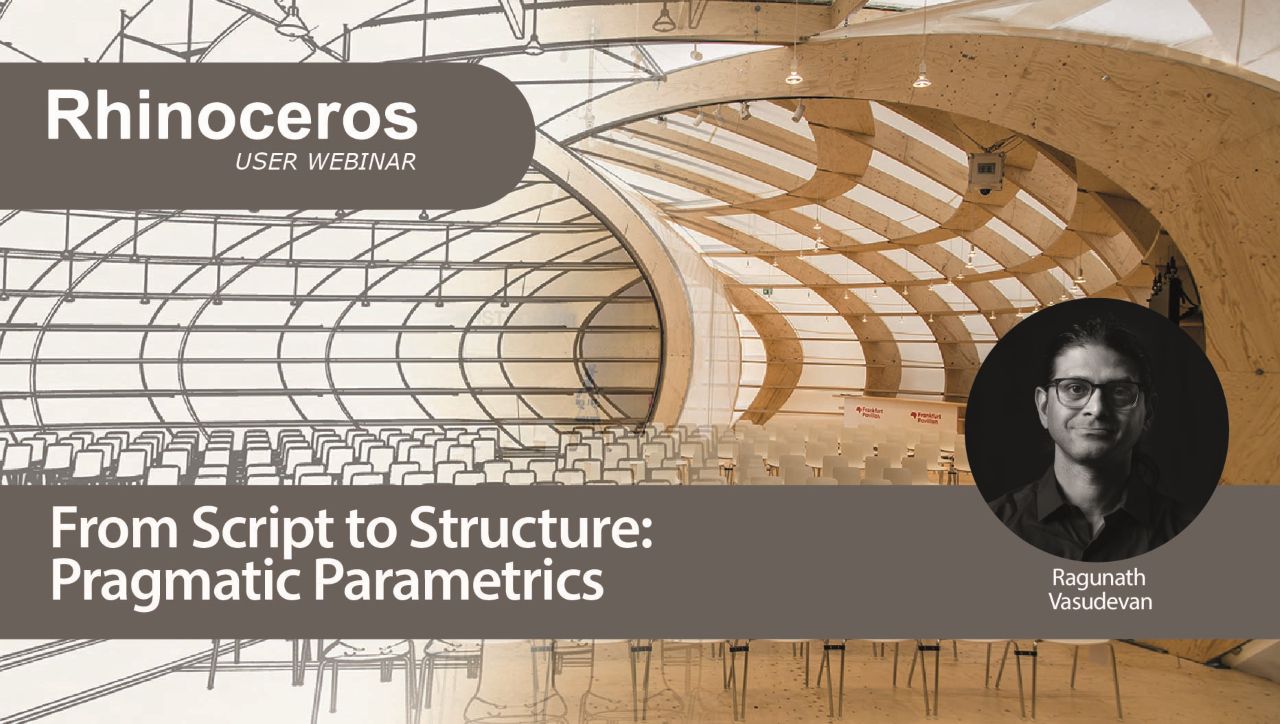
Rhino User Webinar: From Script to Structure – Pragmatic Parametrics


March 25, 2026 - 4:00 PM (CET) 

The webinar will focus on 15 years of parametric design using Grasshopper at schneider+schumacher, featuring projects at very different scales, from a bus stop shelter to a particle accelerator. Through these projects, Grasshopper use will be illustrated across various stages, including design, optimization, and production, across diverse types and scales.

About the speaker:
Ragunath Vasudevan is a Frankfurt-based architect who currently leads the parametric design work at schneider+schumacher Design & Computation. With a professional career spanning over two decades, he specializes in 3D coordination and digital design techniques, having previously held a research position at the University of Kassel. His academic background includes a Bachelor’s in Architecture from the University of Mumbai and a Master of Arts in Advanced Architectural Design from the Städelschule Architecture Class under Ben van Berkel.

Complete details and registration...


Monday, March 9, 2026

Rhino and Grasshopper development services by 4D Pipeline


4D Pipeline 
provides custom plugin development, file format support, API services, and consulting to help organizations extend Rhino's capabilities and integrate it seamlessly with their existing tools and workflows.

4D Pipeline can help with:
  • Custom Rhino/Grasshopper plugin development
    Building specialized tools and automation workflows that extend Rhino's native capabilities for specific industry needs
  • File format support and integration
    Implementing importers, exporters, and translators for proprietary and industry-standard formats, including USD, IFC, ESRI, and custom CAD formats
  • Rhino.Inside integration
    Embedding Rhino's geometry engine and Grasshopper into other 3D applications, enabling NURBS modeling and parametric design within host environments
  • Render engine integration
    Connecting third-party renderers and visualization tools with Rhino, including GPU-accelerated ray tracing implementations
  • Enterprise workflow automation
    Streamlining design-to-production pipelines with custom scripting, batch processing, and system integrations
Services
  • Custom Rhino and Grasshopper plugin development
  • File format importer/exporter development
  • Rhino.Inside implementation and integration
  • Rhino Compute implementation and integration
  • API development and system connectivity
  • Workflow automation and scripting
  • Custom UI/UX for design tools
  • Digital pipelines and interoperability consulting
  • Bespoke Grasshopper components, scripts and parametric tools
  • Relevant Experience
  • Rhino Grasshopper automation project with adidas
  • NVIDIA raytracer integration into Rhino
  • USD implementation for Adobe, Turbosquid, Epic Games, and others
  • IFC support (IFC4 & IFC4x3) using OpenDesign libraries for Customers like ESRI and others
  • Raytracing/renderer Integrations for Lumion, Enscape, and AMD
  • Datasmith and interchange connectors (including for Rhino) for Epic Games and others


Runchat online workshop, April 21-23 (McNeel Europe)


Tutors: Gwyllim Jahn (Fologram, Runchat, RMIT), James Pazzi (Runchat)
April 21-23, 2026
9:30 AM-2 PM CEST (Barcelona)
Hosted on Zoom by McNeel Europe

Runchat is a design agent and visual canvas for automating creative processes inside Rhino. In this workshop, participants will learn how Runchat can enhance creativity and improve productivity across design tasks from concept development and visualization to design development and project management.

The workshop introduces techniques for working with generative images, including diagramming, visual storytelling, and rendering. Participants will learn how to maintain visual consistency across views and animations, make targeted edits to generated images (such as changing materials or accurately placing designs on site), and package these processes as reusable tools for use in design practice.

In the second half of the workshop, participants will explore how to use Claude AI within Runchat to develop tools for modeling, analysis, and project management. Topics include specifying design requirements for language models, simulating design constraints to explore problem spaces, iterating with screenshots and visual markup instead of code, and building simple web applications that integrate with Rhino.

The workshop concludes with a series of case studies demonstrating how Runchat can connect Rhino with other platforms such as Google Maps and Google Sheets, and how generative models are beginning to support more complex parts of the design process, including site research and early-stage planning.

Day 1: Generative Communication
  • Generating photorealistic renders from Rhino screenshots
  • Converting screenshots to stylised drawings and diagrams for visual storytelling
  • Producing quick site mockups from Rhino perspective views
  • Generating concept design variations from simple massing models
  • Automating concept design research using search tools
  • Creating photoreal videos by interpolating Rhino screenshots
  • Generating and importing 3D models and Gaussian splats for concept design
  • Generating and publishing interactive websites, layouts, and presentations
Day 2: Claude AI in Rhino
  • Writing, running and debugging Rhino Python scripts with Claude
  • Providing visual feedback to improve scripts using screenshots
  • Creating custom, reusable design tools from generated Python scripts
  • Running generative design models in Grasshopper for automated 3D model and image generation
  • Integrating ThreeJS simulations for complex modelling and analysis with Rhino
Day 3: Practice Automation
  • Case Study: Using Google Maps in Rhino
  • Case Study: Using Google Sheets in Rhino and Grasshopper
  • Case Study: Automating Site Research
  • Case Study: Drafting Town Planning Applications

Course requirements: Intermediate knowledge of Rhino is required.

Software requirement: Rhino 8

Online course fees: EUR 295 (+VAT). Full-time students and university teachers receive a 50% discount (proof of status required). Please note that we will confirm your seat after your payment has cleared.

Maximum number of participants for each course: 25. If there is no quorum, the course will be canceled 15 days before.

Course language: English

Educational seats are limited. Sign up now by contacting Verena!

Friday, March 6, 2026

New resources for Grasshopper by Cademy xyz


Content Library Image

 
This month, Cademy xyz has published two resources
 to help you build stronger foundations in Grasshopper.


Most beginners get overwhelmed by hundreds of components. Master the 20% of nodes that do 80% of the work with our new guide.

Simulate realistic cables that maintain tension and flow. This tutorial will walk you through how to create dynamic, form-found cables in Grasshopper using the Kangaroo physics engine.

Grasshopper 3D Masterclass dates

  • March 21-22, 2026
  • April 11-12, 2026


Thursday, March 5, 2026

ROB|ARCH 2026: Special session announced - Workshops and registration open!


ROB|ARCH 2026 (August 24-28 in Aarhus, Denmark) is fast approaching.

The organizers invite you to contribute through the Call for this year's Special Session and to explore its intensive 3-day workshop program. The Early Bird registration is now open!

"As part of the ROB|ARCH 2026 conference, we invite the community to contribute to the Special Session, a dedicated platform for work‑in‑progress research, artistic or experimental work, student projects, and design explorations that would benefit from peer discussion but are not intended for inclusion in the conference proceedings."

"Continuing the ROB|ARCH tradition, the Special Session celebrates emerging ideas, speculative directions, and innovative prototypes that advance discourse within robotic fabrication for architecture, design and fabrication, in relation to the conference theme Detangling Dependencies."


Wednesday, March 4, 2026

Window Atlas Graz & Door Atlas Graz – 3D Documentation of Architectural Elements


TU Graz would like to share two recent publications: Fensteratlas Graz and Türatlas Graz, edited by Milena Stavric, Urs Hirschberg, and Britta Nader at Graz University of Technology. 

The books document a wide range of historic windows and doors from Graz, reconstructed through detailed 3D models and analytical drawings. The elements are carefully modeled to reveal their construction logic and components—from window frames and shutters to door panels, handles, hinges, locks, and opening mechanisms.

The atlases combine 3D visualizations, exploded views, typological comparisons, and construction details, offering a useful reference for architects, educators, and students interested in precise architectural modeling.

The books are available as free e-books, and printed editions can also be ordered.


Tuesday, March 3, 2026

Landscape Design Workflow with RhinoLands


Looking for professional landscape architecture software? Check out the upcoming RhinoLands webinar on March 17 at 10:00 AM CET.

This session is designed for professionals and teams who want to improve their landscape design workflow and get more value from RhinoLands in real projects. Whether you are new to RhinoLands or already using it, this webinar will help you work more efficiently and create stronger technical and visual project presentations.

What to expect

During the webinar, you'll explore key RhinoLands workflows and practical features that support landscape architecture and urban design projects, including:

  • Efficient project setup and workflow tips
  • Drawing and technical documentation workflows
  • 3D modeling and project presentation improvements
  • Practical examples for landscape design workflows
  • Live Q&A session

Rhino User Webinar: CAD Workflows for Furniture Design - New recorded webinar now available!

 
Watch now the latest Rhino User Webinar: Behind the model - CAD Workflows for Furniture Design

If you're interested in furniture design and Rhino workflow, take the time to watch this recorded webinar and learn from Ditte Willads Petersen how to build cleaner, lighter, and more efficient 3D models for use across different software, using mesh, NURBS, and SubD geometry.

Through practical examples from furniture design projects from Muuto, she demonstrates soft modelling techniques and structured CAD approaches that help make Rhino models more predictable, organised, and ready for architectural and interior design applications.


Monday, March 2, 2026

RhinoArtisan 6.7


RhinoArtisan 6.7 now includes Assistant, a new intelligent capability built directly inside your jewelry workflow.

Instead of relying on keywords, 
Assistant understands meaning, jewelry language, attributes, and context. It learns from your entire design history across RhinoArtisan, Rhino, Matrix, RhinoGold, and MatrixGold files, allowing you to instantly find designs, similar pieces, pricing data, collections, and production details simply by asking in natural language. 

Assistant works directly with real geometry and executes the commands already available in RhinoArtisan. By simply writing in natural language, you can modify stone geometry following existing concepts, control weight and prepare designs for production, generate presentation-ready renderings by describing materials or lighting, automatically create technical reports, validate manufacturing requirements, and activate manufacturing mode with automatic pricing.

ExactFlat Pattern Making by Sabit


Unlock the full potential of your design and manufacturing workflow by mastering 3D-to-2D digital pattern creation inside
 Rhino using the ExactFlat plugin with this course given by Rhino Authorised Reseller, Sabit.

This hands-on, practice-oriented course teaches you how to turn complex 3D shapes into accurate, production-ready 2D patterns—with realistic simulation of material properties and distortion control. 

From model preparation through flattening, quality control, and export for fabrication, you’ll gain real skills you can apply immediately to upholstery, soft goods, composites, and industrial design projects.

What you’ll get:
  • 100% hands-on, practical training using real ExactFlat workflows
  • Deep dive into professional 3D-to-2D patterning techniques
  • Personalised guidance from an expert Rhino & ExactFlat instructor
  • Skills that are directly applicable to real manufacturing and product design
  • Flexible schedule adjusted to your time zone and availability
  • Live lessons with real-time feedback and mentorship 

Skills you’ll learn:

  • Preparing 3D geometry for flattening with mesh optimisation
  • Understanding material properties, strain, and distortion control
  • Flattening complex surfaces into precise 2D patterns
  • Adding seam allowances, notches, and alignment markers
  • Validating pattern quality with analysis tools
  • Exporting layouts ready for laser cutting, CNC, or digital printing
  • Building reliable workflows for upholstery, soft goods, and composite fabrication 

Software requirements:

  • Rhino (latest version recommended)
  • ExactFlat plugin installed
  • Basic Rhino modelling knowledge recommended 

Format: Live one-on-one training sessions
Interactive lessons with direct instructor support

Next course start: March 10, 2026 (dates may vary)

Duration: 7 sessions, 10 hours total

Language: English, Polish